A Steam page before the game
This post covers how the Steam page preparation is going.
Why validate at all
We’ve already felt why games like this take years: assets, refining the idea, a networked multiplayer prototype, marketing — every item eats weeks before the game itself even exists. We don’t want to sink years into a product nobody wants. So first — a Steam page, and we’ll gauge interest by the number of wishlist adds.
A month to register
Registering as a Steam developer took a month: several rounds of identity verification, documents, waiting for replies. Listing a game costs $100 — Steam refunds it once the game earns $1,000 in revenue. Budget that month into your plan — the page can’t go live without a verified account.
Four drafts of the page text
We rewrote the game description four times. (The store targets a Russian-speaking audience first, so the originals are in Russian — quotes below are translated.)
Draft 1: the marketing wall
Survival Rust Machine is a multiplayer survival game set in a world that lived through a global catastrophe. A huge open world has turned into a dangerous wasteland where the only way to survive is to build your own shelter, explore forgotten territories, and fight other survivors for resources.
Your main ally is an armored car. It’s what carries you on expeditions through ruined cities, abandoned factories, military bases, desert roads, and contaminated zones. Every trip is a risk — dozens of other players are hunting for the same valuable finds.
And five more paragraphs in the same vein: “huge open world,” “every decision matters,” “dominion over the scorched earth.” These lines fit any survival game: an apocalypse with no place or time, and the car — named your “main ally” — drowns among walls, warehouses, and clans.
Draft 2: one day in the game
We cut the pathos and described the game loop as a single day:
Your day starts at the shelter: fuel up the car, bolt on armor, check the machine gun. Then the expedition: ruined cities, abandoned factories, military bases, contaminated zones. That’s where the parts, weapons, fuel, and artifacts are — and dozens of other players are hunting for them too.
The fattest loot sits on strategic points: oil depots, quarries, power plants. They’re never empty; the firefights over them never stop. Take a point — hold it with your team and farm the rare resources.
Everything you haul home goes into the base and the car: reinforce the walls, build workshops and garages, upgrade the engine, mount new weapons. And tomorrow — back into the wasteland, deeper and riskier.
Plus a separate emoji feature block so the page can be skimmed. The car moved to the center of the loop: the day starts with fuel, armor, and the machine gun. But the world stayed a wasteland with no place or time — this text still described any vehicular survival game.
Draft 3: roles
The real find. In the game you don’t pick a role at the start — you earn it through what you do. So the text should sell exactly that:
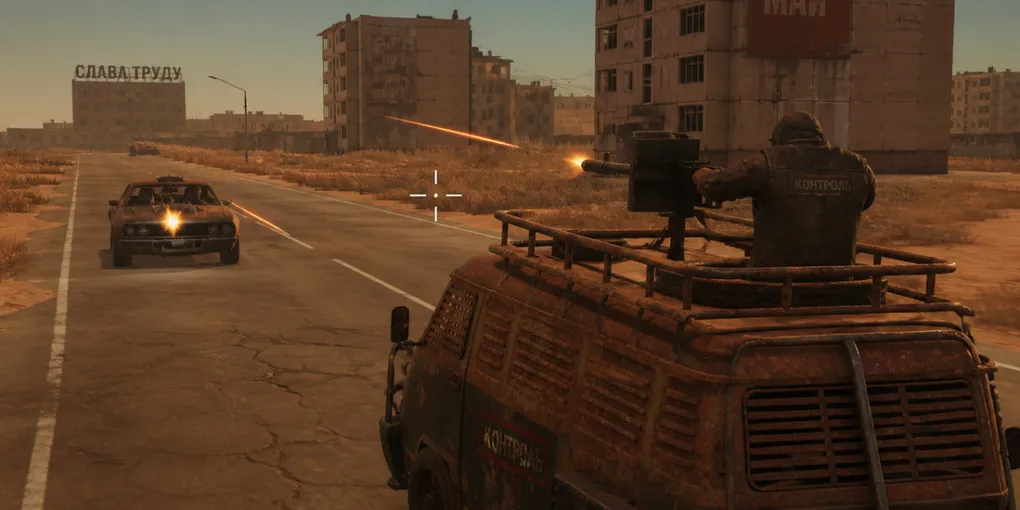
Build an armored monster out of rusty junk. Strip loot from dead apartment blocks and lifeless factories. Shred enemy rustbuckets with your machine gun and kick up radioactive dust in chases. The main thing — get the haul home.
Survival Rust Machine is a multiplayer survival game where your car is your livelihood, your protector, and your weapon. You don’t pick a role here — you earn one: today you dig for resources, tomorrow you take someone else’s, and the day after, if the lawlessness gets old, you hunt bandits alongside the police.
Went out to mine — you’re a resourcer. The route runs through dead apartment blocks, factory floors, and civil-defense warehouses. You load up parts, fuel, artifacts — and try to get it all home. You won’t be lonely: a loaded car is the fattest target in the wastelands.
Decided to profit off others — congratulations, you’re a bandit. You cruise between the apartment blocks or lurk by the highway. Stakeouts, ambushes, chases — anything to take someone else’s… oh no, your loot. Romance.
Or join the police and hold the roads: patrols, checkpoints, chases after those who took it too far. Order at any cost.
The resources you haul in go into the base and the car: walls, workshops, garages, armor, machine guns. And then you choose again who you’ll be when you roll out onto the highway.
The post-Soviet apocalypse appeared — apartment blocks, civil-defense warehouses, the highway — with the car as the core of the game: “your livelihood, your protector, and your weapon.” Plus the three factions from the concept.
Final: the feature list
The hook and the roles stayed from draft three; the feature list got polished, combat vehicles first:
🚗 Combat vehicles. Build and upgrade armored transport: armor, engine, machine guns, extra equipment. Your build decides how you come home.
🏚 Open world. Dead cities, factories, military bases, desert highways, and contaminated zones — there’s something to scavenge everywhere.
📦 Looting and crafting. Rare parts, weapons, fuel, building materials, and unique artifacts. Everything gets used.
🏰 Base building. Walls, workshops, warehouses, repair stations, garages, and defenses. Your home is your fortress.
⚔️ Territory wars. Capture oil depots, quarries, and power plants. Hold the points, repel attacks, control the rare resources.
🤝 Clans and alliances. Team up with players, divide territories, and become the most powerful force in the wastelands.
🎲 Risk and decisions. Push deeper for rare loot or fortify what’s yours? Every decision is a bet. Chases, ambushes, shootouts on the roads.
What’s next
The screenshots are what’s left before the page goes live. Once it does — I’ll share the numbers: what the traffic cost and how many wishlists it brought.